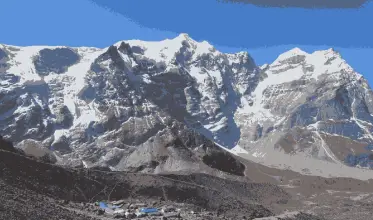
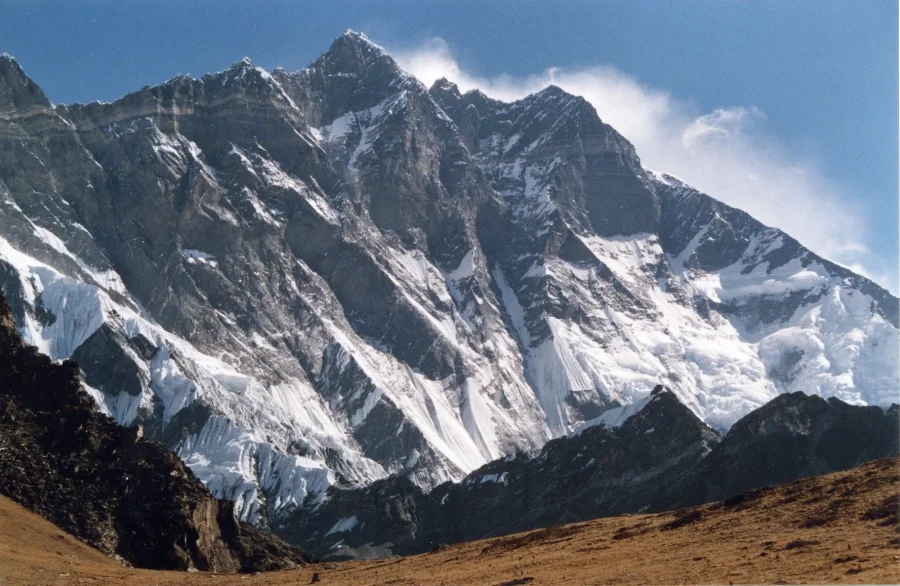
Standing at 8,516 m (27,940 ft), Mount Lhotse offers a demanding Himalayan expedition for experienced mountaineers. Located on the border between Nepal and Tibet, immediately south of Mount Everest, it forms part of one of the world’s most dramatic mountain landscapes. Its Tibetan name means “South Peak,” reflecting its position beside Everest, to which it is connected by the South Col.
Lhotse combines the scale of an 8,000-metre mountain with a distinctive technical summit challenge. Its standard route shares the approach to Everest through the Khumbu Icefall and Western Cwm before branching toward the Lhotse Couloir, the steep gully leading toward the summit. Swiss climbers Ernst Reiss and Fritz Luchsinger first reached the top on 18 May 1956, via the West Face.
The Journey to Base Camp
Your expedition with Sherpa Adventure begins in Kathmandu with equipment checks, expedition preparations, and a team briefing. A flight to Lukla marks the start of the trek through the Khumbu, following trails through Sherpa villages, forests, and high mountain valleys.
The approach provides an introduction to the region’s culture and time for gradual acclimatization. As the landscape opens into glacial terrain, the trail leads toward Everest Base Camp, which also serves as the starting point for the standard Lhotse ascent.
Climbing the West Face and Lhotse Couloir
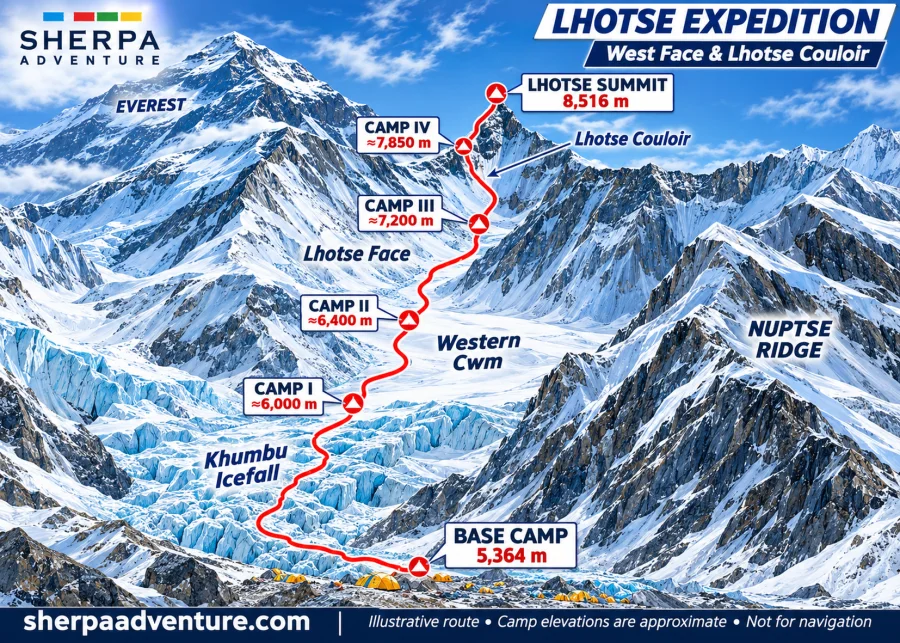
From base camp, the route passes through the Khumbu Icefall, where shifting ice towers, crevasses, and ladder crossings require careful movement. Beyond Camp I, climbers enter the Western Cwm and continue toward Camp II beneath the immense walls of Everest, Lhotse, and Nuptse.
Above Camp II, the ascent steepens onto the Lhotse Face, with fixed-rope climbing toward Camp III. Higher on the mountain, the Lhotse route separates from the Everest route and leads toward a high camp below the summit couloir.
The final ascent is the expedition’s defining challenge. The narrow Lhotse Couloir involves steep snow, ice, and rock, with conditions varying according to seasonal snowfall and weather. At extreme altitude, this terrain demands efficient technique, endurance, and sustained concentration. The summit rewards climbers with an extraordinary perspective of Everest and the surrounding Himalayas.
Preparation, Acclimatization, and Support
The Lhotse Expedition is designed for experienced high-altitude climbers with strong fitness and confident mountaineering skills. Previous expeditions on peaks around 7,000 metres or higher provide valuable preparation, alongside experience with crampons, fixed ropes, abseiling, and steep snow and ice.
Training, acclimatization rotations, and rest periods form an essential part of the expedition. Sherpa Adventure coordinates the journey’s logistics, base camp arrangements, and mountain support, allowing climbers to focus on preparation and recovery.
The climbing schedule remains flexible throughout. Weather, route conditions, and each member’s acclimatization guide decisions on the mountain, with the summit attempt undertaken only when the expedition team considers conditions suitable.



 SEASON
 DURATION
 DIFFICULTY