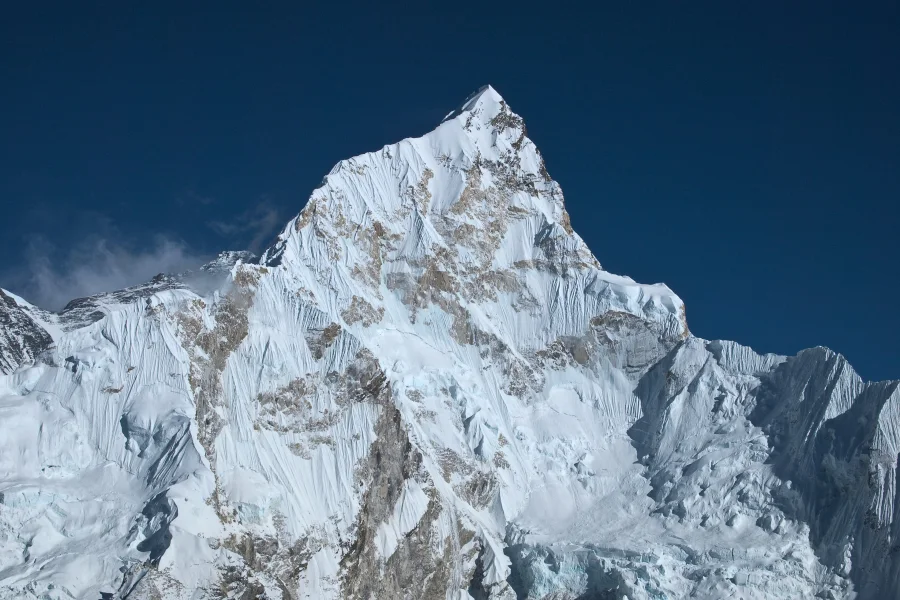
Rising to 7,864 m (25,801 ft), Nuptse forms a spectacular wall of rock and ice beside Everest and Lhotse. Its long, serrated ridge defines the southern boundary of the Western Cwm, while its towering faces dominate views from Everest Base Camp and Kala Patthar. Its name means “West Peak,” reflecting its position west of Lhotse.
For experienced mountaineers, Nuptse offers a demanding objective where technical difficulty matters as much as altitude. Steep climbing, exposed ridges, and complex snow and ice conditions make this a serious expedition requiring strong skills, endurance, and sound judgment.
The main summit was first reached on 16 May 1961 by Dennis Davis and Tashi Sherpa, climbing from the south as part of a British expedition. Later ascents established challenging routes on the mountain’s northern side, approached from the Western Cwm.
The Journey to Base Camp
Your expedition with Sherpa Adventure begins in Kathmandu with equipment checks, a team briefing, and final preparations. A scenic flight to Lukla marks the start of the trek through the Khumbu, passing Sherpa villages, Buddhist monasteries, and forested valleys.
As the trail climbs toward the high mountains, the landscape changes from cultivated fields and woodland to alpine pastures and glacial moraine. Planned acclimatization stops provide time to adjust before reaching Everest Base Camp, the starting point for the northern approach to Nuptse.
The Climb Above the Western Cwm
From base camp, the approach passes through the Khumbu Icefall, where crevasses, ladders, and shifting ice formations demand careful movement. Beyond Camp I, the route enters the Western Cwm—a broad glacial valley enclosed by Everest, Lhotse, and Nuptse—and continues toward Camp II.
From the upper valley, the Nuptse climb leaves the shared approach and heads onto the mountain’s northern slopes. Steep snow, ice, and mixed terrain lead toward the upper mountain, where exposure and the demands of altitude increase.
The summit section is particularly committing. Narrow ridges, potential cornices, and strong winds require careful assessment, with the climbing line and camp arrangements determined by the selected route and conditions. Reaching the summit depends on both the team’s readiness and a suitable weather window.
Experience, Acclimatization, and Expedition Support
Nuptse is suited to experienced technical mountaineers with a proven high-altitude background. Previous ascents of trekking peaks alone are not sufficient preparation: participants should be confident on steep ice and mixed terrain, experienced with fixed ropes and abseiling, and capable of sustained effort in exposed conditions.
Training sessions, acclimatization rotations, and recovery days form an essential part of the expedition. Sherpa Adventure coordinates permits, transport, base camp logistics, and climbing support around the agreed program.



 SEASON
 DURATION
 DIFFICULTY